
Why Choose The Solomon Islands?
Click on each tab below for some more information that may help you to take that journey to the Happy Isles.
Located in the continent of Oceania, The Solomon Islands covers 30407 square kilometres over 992 islands. It consists of a double chain of volcanic islands and coral atolls in Melanesia. The country comprises most of the Solomons chain—with the exception of Buka and Bougainville, two islands at the northwestern end that form an autonomous region of Papua New Guinea.
The currency is the Solomon Dollar (SBD). It is made up of 5,10,20,50 and 100 dollar notes. Coins are 10, 20 and 50 cents and 1 and 2 dollar. There are appoximately 5 SBD to 1 AUD and 8.2 SBD to 1 USD (Nov 2025).
The people are classed as Solomon Islanders.
The dialing code for the country is 677 and the top level internet domain is .sb.
The Solomon Islands has no land border.
Vehicles drive on the left side of the road (mostly!)
Population estimate (2025) is 838,000
Electricity Supply is 240 volts and power points are ‘Type I’ the same as used in Australia and New Zealand
The islands have been settled since at least some time between 30,000 and 28,800 BCE, with later waves of migrants, notably the Lapita people, mixing and producing the modern indigenous Solomon Islanders population.
1568 – The islands were named by the first European visitor, Spanish navigator Alvaro de Mendana, who claimed that he had found the riches of King Solomon, or the biblical land of gold.
1893 – Britain defined its area of interest in the Solomon Islands archipelago, when Captain Gibson, R.N, of HMS Curacoa, declared the southern Solomon Islands a British protectorate.
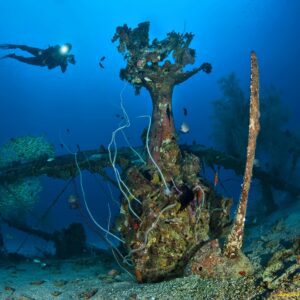
1942 – 1945 – major Pacific fighting took place between British/US forces and the Japanese Empire, including the Battle of Guadalcanal. Many relics remain from the war with many ships and aircraft becoming superb underwater dive sites.
1975 – The official name of the then-British administration was changed from the “British Solomon Islands Protectorate” to “The Solomon Islands”, and self-government was achieved the following year. Independence was obtained, and the name changed to just “Solomon Islands”.
1978 – Solomon Islands became a constiution Monarchy with firstly, Queen Elizabeth II and now King Charles III as its Head of State.
The Solomon Islands have a warm, tropical climate all-year-round. Temperatures across the country range between 25-32°C and precipitation ranges between 3000-5000 millimetres annually. The tropical wet season in the Solomon Islands normally runs from November to May when tropical cyclones can form in the Coral Sea. The North West monsoon season runs from December to March, and the South East season is from May to October.
The most popular surf destinations are on the Northern island coasts, so the months of October to April are most favourable for decent surf conditions. On the southern coasts, the opposite months are better for surfing.
The main tourist season falls in the Northern dry season, from April to November, when conditons are most sutable for birdwatching, fishing, trekking, festivals and basking in the tropical sun in one of our resorts.
Scuba Divers and anglers visit the Solomon Islands all year round.
Solomon Islanders are some of the most beautiful and friendly people on earth. They will generally greet you with a wave, a smile, or a hello and the kids are so inquisitive that they will follow you around and want to join in with your activities.
Solomon Islanders are classed as Melanesians, with the population of over 700,000 made up of 94.5% Melanesian, 3% Polynesian, and 1.2% Micronesian.
Melanesia is a subregion of Oceania extending from New Guinea island in the southwestern Pacific Ocean to the Arafura Sea, and eastward to Tonga. The region includes the four independent countries of Vanuatu, Solomon Islands, Fiji, and Papua New Guinea, as well as the French special collectivity of New Caledonia, and the Indonesian region of Western New Guinea. Most of the region is in the Southern Hemisphere, with a few small northwestern islands of Western New Guinea in the Northern Hemisphere.
The offical language that is spoken in Parliament and taught in schools is English, but there are over 120 local languages and dialects throughout the country. Solomons Pijin is commonly spoken thoughout.
Anti-malarial medication, Hepatitis B, cholera and other vaccinations may be required, so ensure that you visit your doctor or a Traveller’s Medical and Vaccination Centre to seek advice.
Tropical strength personal insect repellent should be worn in coastal regions, particularly around dusk, to help repel mosquitoes and midges. With the high humidity, if you become ill on your holiday, most hotels keep a contact number for the local doctor. Payment is required at the time of consultation.
Hospitals are poorly equipped and shortages of common medicines sometime occur, however, pharmacies are usually well stocked with the common remedies.
You should never travel without adequate insurance cover. Australian residents can obtain a quote here. Citizens of other countries, contact your preferred agent.
Your passport must have a validity of at least six months beyond your stay to be allowed in the country.
Tourist visas for passport holders from Commonweath countries, USA, and most European nations can be obtained on arrival. For more information relating to visas, please visit here.
Here are some useful links:
Solomon Island Consulates
Tourism Solomons
Australian Border Control
Lonely Planet Guide
Public Holidays 2026
Duty Free Allowances – Solomons
Duty Free Allowances – Australia
Prohibited Imports and Exports
English – Pijin Dictionary
Solomon Island Holidays (SIH) acts solely as a third-party travel agent and does not own, operate, or control any tours, transportation services, accommodation, or other travel-related products in the Solomon Islands. All services are provided by independent local operators recommended by Tourism Solomons.
Clients are strongly advised to obtain comprehensive travel insurance to cover any delays, cancellations, or disruptions caused by airlines, tour operators, or accommodation providers, as such events are beyond the control of SIH.
The Solomon Islands are a developing country, and some aspects of travel may differ from what you are accustomed to at home. Limited internet or phone coverage, power outages, cold showers, lack of air-conditioning, flight or transport delays or cancellations, lower vehicle standards, less formal staff training, and boats without standard safety equipment may occur.
The Solomon Islands are ideal for travellers who value world-class, uncrowded diving, true island remoteness, and authentic cultural experiences, but are less suited to those seeking ultra-polished luxury resorts, extensive spa facilities, or highly curated resort-style indulgence.
Travellers are asked to remain patient and calm, as frustration or raised voices will not improve these situations. Approaching the Solomon Islands with curiosity, flexibility, and an open mind—rather than fixed expectations—will lead to a far more rewarding experience.
Our full terms and conditons can be viewed here.
-

A Taste of the Solomons 1 – Guadalcanal & Rennell
-
A Taste of The Solomons 2 – Santa Isabel Pitta Hunt
-
A Taste of the Solomons 3 – Gizo & Kolombangara
-
Coral Sea Resort & Casino
Price range: $380.00 through $670.00 -
Fatboys Resort Gizo
Price range: $810.00 through $6,250.00 -
Gentle Solomons
-
Honiara Hotel 3 Night Stay
Price range: $350.00 through $450.00 -
King Solomon Hotel 3 Night Stay
Price range: $749.00 through $799.00 -
Na Finua Private Island Retreat
$2,700.00 -
Sanbis Resort