
Located in the continent of Oceania, Papua New Guinea covers 452,860 square kilometres of land and 9,980 square kilometers of water, making it the 55th largest nation in the world with a total area of 462,840 square kilometers.
The currency of Papua New Guinea is the Kina (PGK). As well, the people of Papua New Guinea are referred to as Papua New Guinean.
The dialing code for the country is 675 and the top level internet domain for Papua New Guinean sites is .pg.
Papua New Guinea shares land borders with only one country, Indonesia.
Vehicles drive on the left side of the road (sometimes!). Pot holes can be deeper than lakes (lol)
Electricity Supply is 240 volts and power points are ‘Type I’ the same as used in Australia and New Zealand
1523 – Portuguese sailor Jorge de Meneses, names part of the present day Papua New Guinea Ilhas dos Papuas, which translated means “land of people with frizzy hair”.
1546 – Spanish Explorer names the island New Guinea as he believed the inhabitants resembled the people of Guinea in West Africa.
1884 – the island is divided by agreement, with Holland ‘acquiring’ the western part (now West Papua), Germany the north east (New Guinea) and Britain the south east (Papua).
1906 – Australia assumes control of British Papua.
1914 – Australia occupies German New Guinea.
1921 – The League of Nations gives Australia a mandate to govern New Guinea, whilst still ruling Papua as a colony.
1945 – Australia merges its administrations of Papua and New Guinea.
1975 – Papua New Guinea becomes an independent nation with Michael Somare appointed Prime Minister.
1989 – civil war starts on Bougainville, triggered by disagreement over royalties from the Panguna Copper Mine.
2001 – peace agreement reached with Bougainville involving greater autonomy and a referendum ‘planned’ to be held by 2020 offering an option for independence from PNG.
2019 – Referendum held in Bougainville for locals to vote on whether to stay a part of PNG or to be an independent nation
The tropical wet season in Papua New Guinea normally runs from November to May. The North West monsoon season runs from December to March, and the South East season is from May to October. Coastal areas average 25-30ºC during the day with high humidity and warm nights. The further inland or higher the altitude, the lower the temperature will be. The nights are milder and more bearable in the Highlands.
The most popular surf destinations are on the Northern coasts of PNG, so the months of October to April are most favourable for decent surf conditions. The main tourist season falls in the Northern dry season, from April to November, when conditons are most sutable for birdwatching, fishing, trekking, festivals and basking in the tropical sun in one of our resorts.
Scuba Divers visit PNG all year round.
PNG is always in the news and usually it’s for the wrong reasons. In general, incidents involving foreigners are isolated and in many cases, are blown out of proportion by the media. There is usually a good reason for the problem and this does not always get reported to the public. The majority of trouble occurs in the larger cities and towns and is often related to tribal issues, particularly in the Highlands.
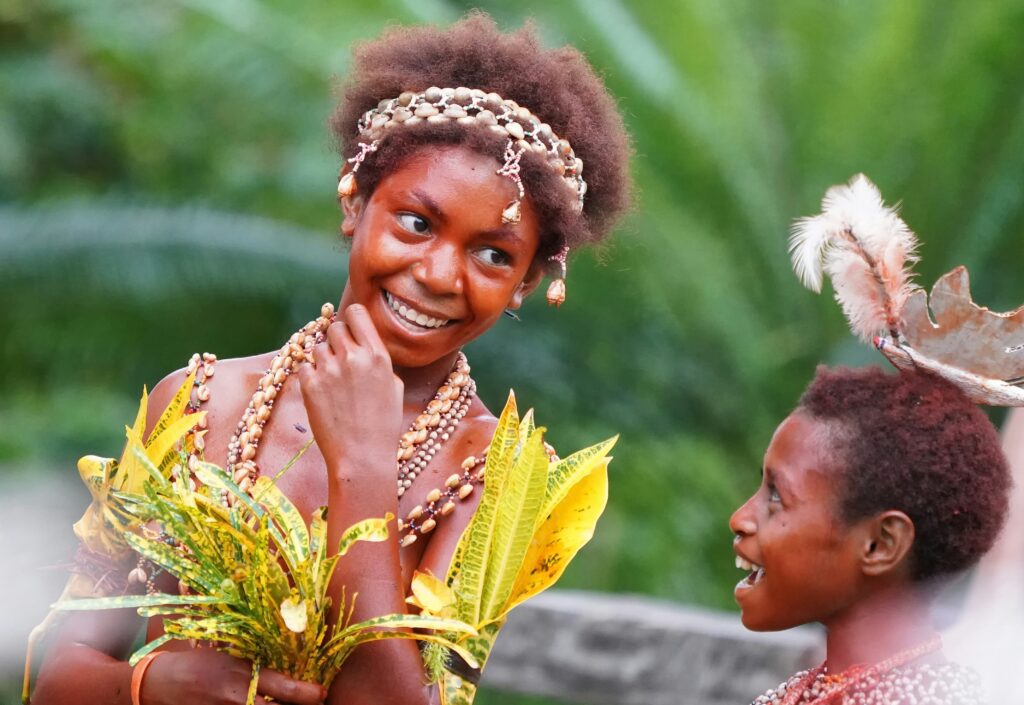
The majority of Papua New Guineans are some of the most beautiful and friendly people on earth. They will generally greet you with a wave, a smile, or a hello and the kids are so inquisitive that they will follow you around and want to join in with your activities.
PNG people are classed as Melanesians. Melanesia is a subregion of Oceania extending from New Guinea island in the southwestern Pacific Ocean to the Arafura Sea, and eastward to Tonga. The region includes the four independent countries of Vanuatu, Solomon Islands, Fiji, and Papua New Guinea, as well as the French special collectivity of New Caledonia, and the Indonesian region of Western New Guinea. Most of the region is in the Southern Hemisphere, with a few small northwestern islands of Western New Guinea in the Northern Hemisphere.
The offical language that is spoken in Parliament and taught in schools is English. People from the New Guinea side of the country (former name under German rule) is Tok Pisin, a mix of English, German, Malay and Portuguese originating from colonial days. In the southern part of the country Hiri Motu is widely spoken, although in recent times, Tok Pisin and English are becoming more common.
Anti-malarial medication, Hepatitis B, cholera and other vaccinations may be required, so ensure that you visit your doctor or a Traveller’s Medical and Vaccination Centre to seek advice.
Tropical strength personal insect repellent should be worn in coastal regions, particularly around dusk, to help repel mosquitoes and midges. This is not necessary in the Highlands as the climate does not suit mosquitoes. With the high humidity, if you become ill on your holiday, most hotels keep a contact number for the local doctor. Payment is required at the time of consultation.
Hospitals are poorly equipped and shortages of common medicines sometime occur, however, pharmacies are usually well stocked with the common remedies.
You should never travel without adequate insurance cover. Australian residents can obtain a quote here. Citizens of other countries, contact your preferred agent.
Your passport must have a validity of at least six months beyond your stay to be allowed in the country.
Citizens of many countries, including Australia, require a valid visa or entry permit before travelling. Tourist visas can be applied for online through PNG’s Immigration & Citizenship Authority. Citizens of Pacific Nations are currently eligible for a free 60 day visa on arrival.
All travellers must complete a Digital Arrivals Card online within 3 days of travel.
As of October 2025, Papua New Guinea introduced a Green Fee departure tax for all foreign adult passengers departing the country. The fee is PGK 50, payable in cash, equivalent to approximately USD 12, EUR 10 or AUD 18. Airline crew, military personnel and short-term transit passengers are exempt from this charge.
Here are some useful links:
PNG Holidays acts solely as a third-party travel agent and does not own, operate, or control any tours, transportation services, accommodation, or other travel-related products in Papua New Guinea. All services are provided by independent local operators recommended by the Papua New Guinea Tourism Promotion Authority.
Clients are strongly advised to obtain comprehensive travel insurance to cover any delays, cancellations, or disruptions caused by airlines, tour operators, or accommodation providers, as such events are beyond the control of PNG Holidays.
Papua New Guinea is a developing country, and some aspects of travel may differ from what you are accustomed to at home. Limited internet or phone coverage, power outages, cold showers, lack of air-conditioning, flight or transport delays or cancellations, lower vehicle standards, less formal staff training, and boats without standard safety equipment can all occur.
We ask that travellers remain patient and calm, as frustration or raised voices will not improve these situations. Approaching Papua New Guinea with curiosity, flexibility, and an open mind—rather than fixed expectations—will lead to a far more rewarding experience.
Our full terms and conditons can be viewed here.
Whether you’re in PNG for business or leisure, we will find you a suitable property to suit your requirements.
Papua New Guinea (PNG) Holidays aims to promote Papua New Guinea as a safe and exotic holiday destination to the rest of the world. We will provide exciting and unique holiday experiences to a destination unlike anywhere else in the world, encourage respect and understanding of Papua New Guinea Culture and nature and will ensure that future tourism activity to and within Papua New Guinea is sustainable for the future of everyone – locals and visitors alike.
The company is the vision of a few of us who have experienced PNG first hand and have a passion and understanding for Papua New Guinea and its exotic cultures, wildlife and pristine natural landscapes that remain virtually untouched by modern civilization. There has been much negative press towards PNG and its political instability, equally so mis-representation has taken place with regards to many of the outlying provinces that remain unscathed by the security issues of the capital – Port Moresby. We intend to redress the balance.
Experience, Local Connections & Peace of Mind
It is time to reveal the hidden gems of Papua New Guinea and open the doors to a country that as a Tourism Destination is already gaining momentum and developing it’s own tourism infrastructure and understanding the importance of this aspect of it’s economy. We will help Papua New Guinea to achieve this every way we can. Some of the benefits of allowing PNG Holidays arrange your next adventure are:


Andrew
Owner PNG/Solomon Island HolidaysAndrew lived in PNG in the 1990s and first born child was born in Madang Hospital. Having been posted to Lae, Madang, Goroka, Kainantu, and Manus, he has been involved wth PNG Holidays since 2009 and has travelled extensively throughout the country, sourcing the best properties and tours to offer his clients.

Martin
Owner Business & Leisure TravelMartin started the company in 2007, after living and travelling extensively throughout Papua New Guinea. He and his wife Michelle also own Business and Leisure Travel, a north Queensland based company, with 2 fully licenced and accredited travel agencies in the region.